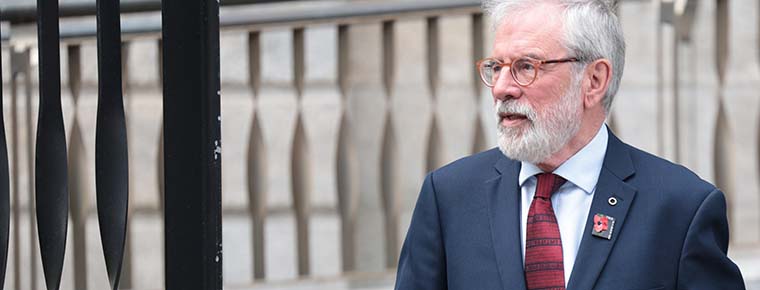
‘No clear guidance’ from Adams defamation trial
RDJ partner Darryl Broderick says that the recent defamation trial involving former Sinn Féin President Gerry Adams and the BBC does not give any clear guidance on the applicability of Irish defamation law, even as it stands.
Last month, a jury in a High Court trial in Dublin awarded Adams €100,000 in damages after finding that he had been defamed in a BBC Spotlight television programme broadcast in 2016.
Adams had claimed that the Spotlight programme suggested that he sanctioned the 2006 murder of former Sinn Féin official and British agent Denis Donaldson.
Abolition of juries
In an analysis on the firm’s website, Broderick writes that the case confirms the long-held belief that jury awards are notoriously difficult to predict.
The current version of the Defamation (Amendment) Bill 2024 seeks to abolish juries.
“While there have been some staunch defenders of juries in High Court defamation trials, all current indications are that when the bill is enacted, juries will ultimately be abolished, and the unpredictability of their awards, which tends to favour plaintiffs more than defendants, will be a thing of the past,” the RDJ partner states.
Public-interest defence ‘overly complex’
Looking at the BBC’s reliance on the defence of “fair and reasonable publication on a matter of public interest” in the Defamation Act 2009, Broderick notes that there has yet to be a High Court case in this jurisdiction where this defence has been successfully relied on.
That defence enables a publisher to defend a defamation claim even where they have published false information, but where they have done so in good faith, having followed appropriate journalistic and editorial standards.
“The defence is regarded in legal circles as overly complex and difficult for a jury to understand,” Broderick writes.
He notes that a proposal contained in the draft 2024 bill to simplify this defence is not included in the current version.
“While the bill may yet be subject to changes, a failure to amend this defence would be worrying for media defendants in defamation claims,” the RDJ lawyer states.
‘Medium’ damages
Broderick describes the jury’s decision to award Adams €100,000 as “difficult to interpret”, pointing out that this amount is regarded as ‘medium’ under non-binding Supreme Court guidelines laid down in the 2022 case Higgins v Irish Aviation Authority.
“Adams’ claim was that he had been accused by the BBC of sanctioning a murder. It is hard to conceive of a more serious allegation,” he writes.
“It does not seem that the award in the Adams’ case gives any real guidance as to how juries will apply the Higgins guidelines on damages. In any event, in light of the progress and contents of the bill, it does not seem that there are going to be too many more jury defamation awards in this jurisdiction,” Broderick concludes.