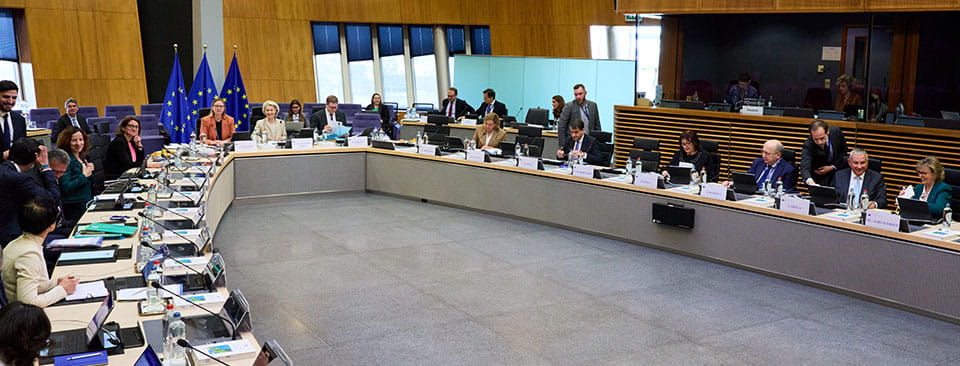
EU sets out 48-hour company-formation plan
The European Commission has put forward its proposals for a new single set of corporate rules aimed at making it easier for companies to start up and grow across the EU.
Justice commissioner Michael McGrath said that the proposal, known as EU Inc, would allow entrepreneurs to set up a business within 48 hours, at a maximum cost of €100.
“A once-only, fully digital submission process reduces administrative burdens, giving entrepreneurs more time to focus on growing their businesses,” he stated.
Legal landscape ‘fragmented’
The commission says that, for far too many entrepreneurs and firms, expanding across EU borders means navigating a fragmented corporate legal landscape, with 27 national legal systems and more than 60 forms.
It stresses that EU Inc will not replace national company frameworks, and will be an optional harmonised framework available across the EU available to all companies.
“Any entrepreneur will be able to create a company within 48 hours, from anywhere in the European Union, and fully online.,” said commission president Ursula von der Leyen, adding that “this crucial step is just the beginning”.
The commission is calling on the European Parliament and the EU Council to reach an agreement on the proposal by the end of 2026, because of its “key importance for the EU’s prosperity”.
Employment laws not affected
The main features of EU Inc include:
- Faster registration,
- Simpler procedures: EU Inc companies will need to submit their company information only once, through an EU-level interface connecting national business registers,
- Fully digital operations,
- EU Inc companies will have access to fully digital liquidation procedures, while innovative start-ups will have access to simplified insolvency procedures to facilitate the winding down of operations,
- The proposal will remove in-person formalities, provide digital procedures for financing operations, and simplify the transfer of shares, with no more mandatory involvement of intermediaries for share transfers, and liquidation procedures,
- EU Inc companies will be able to set up EU-wide employee stock option plans,
- EU Inc companies will be free to choose the member state in which they incorporate,
- National employment and social laws are not affected by the proposal, and
- EU Inc companies will have the flexibility to create different classes of shares with varying economic or voting rights.
The potential inclusion of harmonisation measures in areas such as taxation or employment had been a concern among some lawyers.
The commission has also adopted a communication outlining ongoing and future initiatives to complete what is known as the EU’s 28th Regime for company law in other policy areas.
Specialised courts
It proposes maximum digitalisation of interactions between companies and public authorities and calls on member states to consider setting up specialised judicial chambers or courts with the authority to handle disputes on EU Inc company law.
The EU body has also set out a recommendation on the definitions of ‘innovative enterprises’, ‘innovative start-ups', and ‘innovative scale-’ups’.
This is aimed at ensuring a coherent approach across the EU to provide certainty for companies, investors, and decision-makers.